
Tool Setters and Offsets
Creating a Tool Setter
Open the Calibrate Tool Setters window. Found on the Tools tab.

Creating a Manual Tool Setter
|
|
|
|

-
-
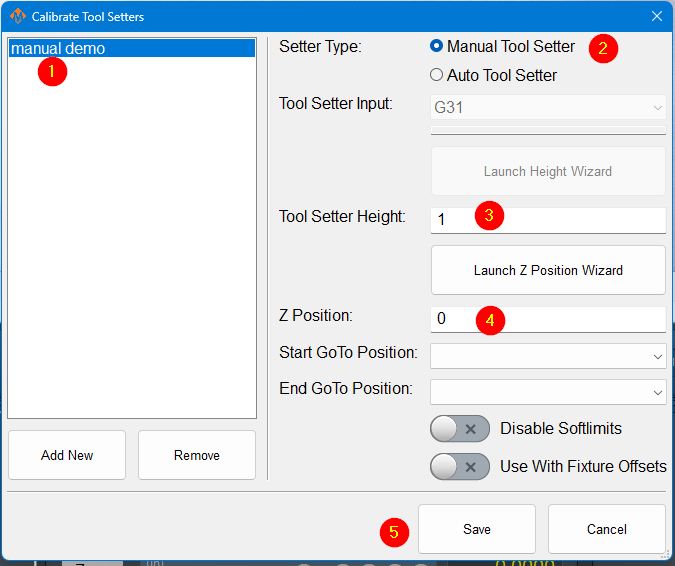
In the Tool Setter tab, click Add New to create a new tool setter.
-
Each tool setter must have a unique name.
-
After naming it, select it from the list to display its settings on the right-hand side.
-
-
Under Setter Type, select Manual.
-
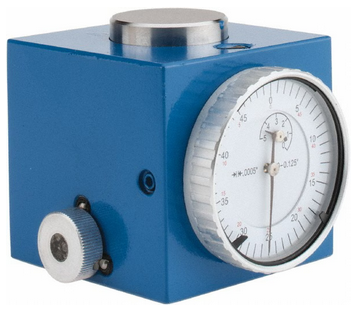
Measure the height of the tool setter and enter the value in the Tool Setter Height field.
-
Set the Z Position.
-
For a fixed-mounted setter, use the Z Position Wizard to determine the machine coordinate for the top surface of the setter.
-
Once this value is set correctly, it will not need to be changed.
-
If the setter is mounted outside the soft limits, enable Disable Softlimits.
-
-
(Optional) Set a GoTo Position.
-
Define a position so the spindle can safely move to the tool setter before touch-off.
-
This ensures a consistent approach and reduces the risk of crashes.
-
-
For randomly placed setters or variable table heights, set the Z Position to 0.0 and leave all GoTo fields blank.
-
This indicates that the setter position may change between uses.
-
-
Click Save to apply and store the configuration.
Once the Z position and height are calibrated, the system will automatically use these values for all tool length offset calculations.
-
Using a randomly placed tool setter

-
Remove all tools from the spindle.
-
-
If the spindle uses tool holders or collets, insert an empty holder while setting the Z position.
-
-
-
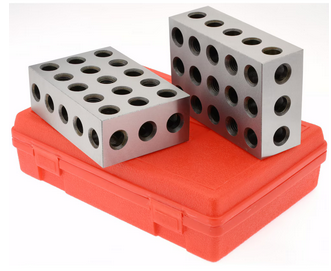
Place the manual tool setter or gauge blocks on the table at the desired location.
-
Carefully jog the spindle down until the tip touches the surface of the setter.
-
-
Click Set Position.
-
-
This sets the Z position based on the current spindle location and the entered height of the tool setter.
-
-
-
Insert and measure each tool required for the job.
-
-
Perform a tool measurement cycle for each tool to record its length offset
-
-
Creating an Auto Tool Setter
 |
|
-
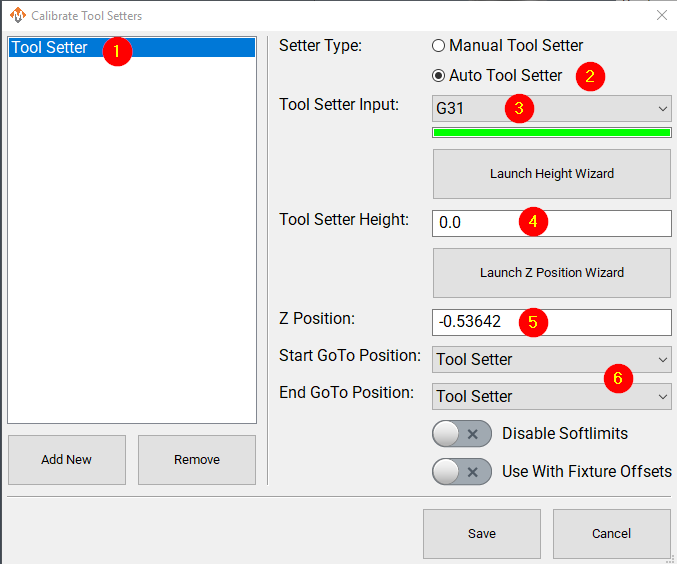
Click Add New to create a new tool setter.
-
Enter an appropriate name for the tool setter.
-
-
Set the Setter Type to Auto.
-
Select the Probe Input that the tool setter is wired to.
-
The indicator bar below the input selector will turn green when the tool setter is triggered.
-
Manually trigger the setter (or have a helper do so) to confirm the correct input is selected.
-
-
If the tool setter height is known, enter the value in the Tool Setter Height field.
-
If the height is unknown, click Launch Height Wizard and follow the on-screen instructions to measure it.
-
The tool setter must be wired to the control for this process.
-
-
Set the Z Position to the machine coordinate of the surface where the tool setter rests.
-
If the position is unknown, use the Z Position Wizard to determine it.
-
For a randomly placed setter, set the Z Position to 0.0. This value will be defined each time before measuring tools.
-
See also: Using a Randomly Placed Tool Setter.
-
-
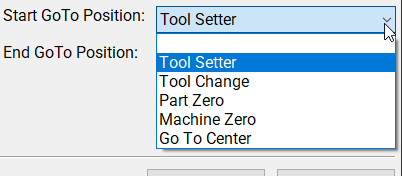
(Optional) Define GoTo Positions for the tool setter.
-
Selecting a GoTo position allows the spindle to move automatically to the setter before touching off.
-
This is recommended for permanently mounted setters.
-
If the setter is located outside the soft limits, enable Disable Softlimits.
-
-
For randomly placed setters, leave all GoTo Position fields blank.
-
Manually jog the spindle to the setter or place the setter beneath the spindle as needed.
-
The machine will not perform automatic jogging during this process.
-
Align Tool Edge to Center of Tool Setter
-
Enable the feature by setting Tool Setter Align Tool Edge To Setter to Yes.
-
Configure the Tool Setter Align Tool Edge Offset parameter.
-
Choose between Tool Radius or Tool Setter Offset as the source for the offset used to align the tool edge to the center of the setter.
-
-
Select the Offset Direction to define which way the tool moves when aligning the edge to the center of the setter.
This feature positions the edge of the tool precisely at the center of the tool setter, ensuring accurate alignment and consistent measurement results.
Configure the following Parameters:
| Parameter Name | Value | Optional Values | Default Values |
| Tool Setter Align Tool Edge To Setter | Yes | No | |
| Tool Setter Align Tool Edge Offset | Tool Setter Offset | Tool Radius, Tool Setter Offset | Tool Radius |
| Tool Setter Align (X or Y) Axis To Setter | X Positive | X Positive, X Negative, Y Positive, Y Negative | X Positive |
Parameter "Tool Setter Align Tool Edge Offset" must be set to "Tool Setter Offset" before the Tool Setter Offset column will show up in the tool table.
The tool table can be edited and customized extensively to meet the needs of your system. Please see Tool Offset Table Customization
Modifying GoTo Positions

Now select the GoTo Positions tab.
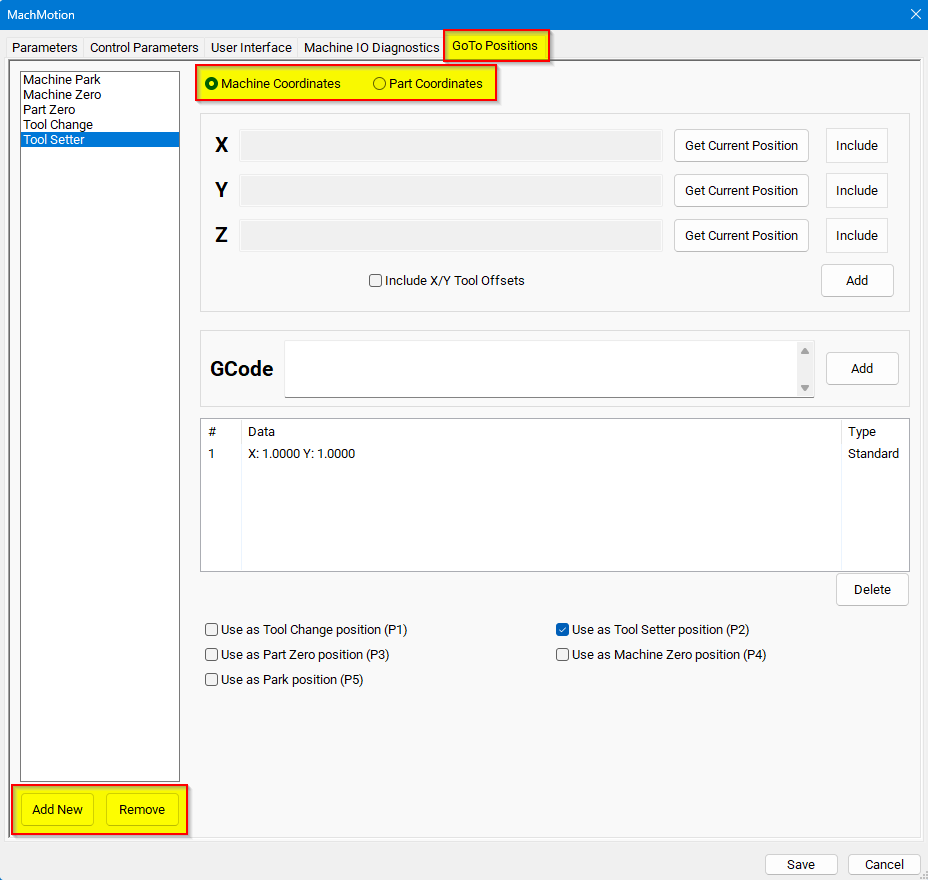
Position Setup Instructions
-
YouUsecanthe Add or Removea position with thebuttons at thebottom.bottom to manage positions. -
When
you addadding a new position,carefullychooseselectMachinemachineCoordinates orpartPartcoordinatesCoordinates at the top. -
YouTocan also selectchange an existingpositionposition,toselectmodify it.In both new positionsit andmodifiededitpositionsasyouneeded.are -
Each position builds a movement list
of movementsin the Databox.Box.You can use theUse Deletebuttonto removemovements.a movement. -
If you are creatingFor atoolToolsetterSetterposition,Position, jog the machine to the correct location. -
YouTocanadd a custom G-code line, writeyouritownandcustomclickgcode line. Hit "Add"Add toaddincludethisittoingotothe Goto list.
⚠️Note:DoDO NOTnot use M Codes here.
Thisishelpsone way to getmove the toolup and out of the waysafely beforemaking anyothermovements.operations.

Add Movement Instructions
-
Click
theIncludebuttonsfortheeachaxesaxis you want tomovemove.next. -
Click
theGet Current Positionbutton for each relevant axisto copyin theirthe current coordinates, ormanually entertype thecoordinates.coordinates manually. -
Click
theAdd/Updatebuttontoaddsavethatthe movementtoin thedataDatasection.Section.
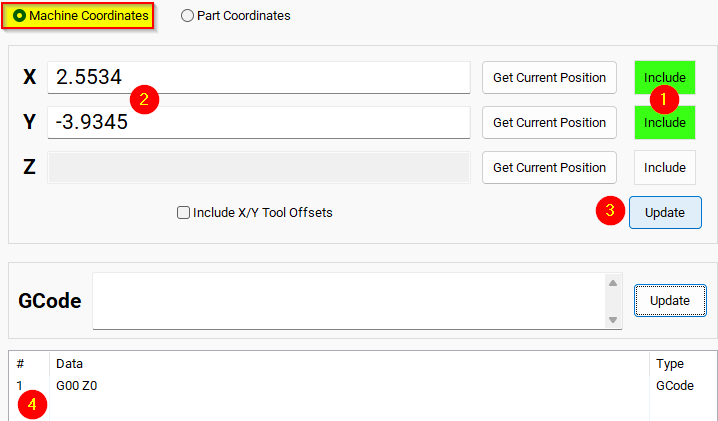
Example: Z-Axis Movement
-
IDefinehavethedefined a ZZ-axis movementthattoI want performedrun first.When -
click theClick Add/Update
button,to insert thisconfigurationmovementwillintobetheinsertedData Box. -
Add more actions in the
data box. Additional actions will be added in followingnext rows.I -
Optionally, add a final Z
rapidRapidmovementMove to bring the toolcloserclose to the setter.


I modified the Tool Setter position. Coordinate lines in the Data box will be in Machine Coordinates. This will be used as the Tool Setter position and can be called using the P2 variable.